
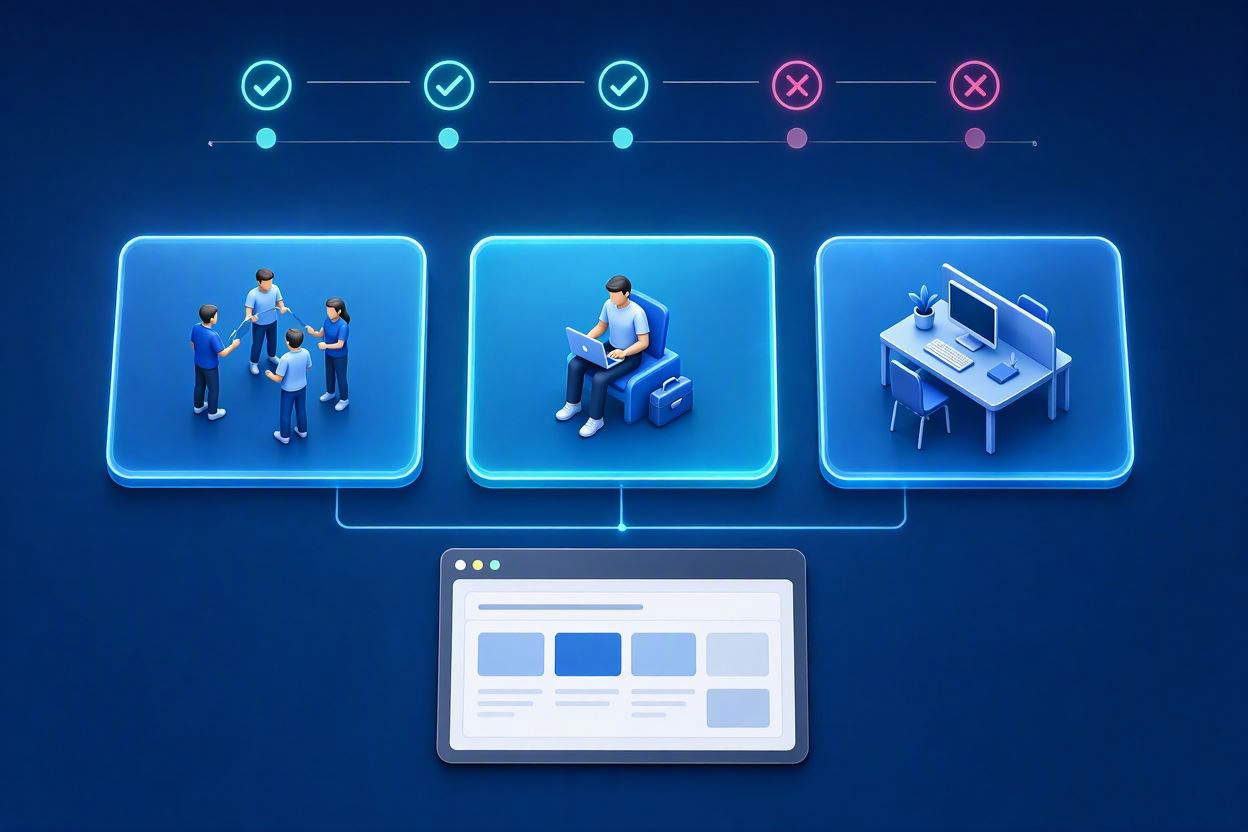
Finding a Joomla developer is not the problem. The problem is choosing the format: hire in-house, take a freelancer, or work with an outsourcing team. Each option has pros and cons. We have been working in outsourcing for over 5 years and have seen different situations. Let's look at the three models objectively.
Three Work Models
What we compare:
- Outsourcing — a team on the partner's side.
- Freelancer — one independent contractor.
- In-house developer — an employee on staff.
Each model suits its own tasks. There is no universal answer.
Outsourcing: Pros
What is good:
- A team — not one person, but specialists for each task.
- Scalability — the scope can grow.
- Flexibility — engage as tasks arise.
- Expertise — Joomla specialization.
- Fast start — no searching or training.
- Confidentiality — NDA and white-label.
- Predictability — contract, timeframes, reports.
Outsourcing is a team without the obligations of in-house staff.
Outsourcing: Cons
What to consider:
- Cost — higher than a freelancer.
- Less control — they do not sit in your office.
- Dependency — if the partner is loaded, you wait.
- Communication — via agreed channels.
- Onboarding — the first days go to studying the project.
Outsourcing suits a constant flow of tasks.
Freelancer: Pros
What is good:
- Price — often cheaper than outsourcing and in-house.
- Flexibility — you can hire for a task.
- Direct contact — you talk to the contractor directly.
- Fast start — gets to work quickly.
- Variety — easy to find one for a niche.
A freelancer is a quick way to close one task.
Freelancer: Cons
What to consider:
- One person — does not scale.
- Availability — may disappear, get sick, leave.
- Responsibility — hard to hold to commitments.
- Expertise — not always a Joomla specialist.
- Risks — no guarantees or NDA.
- Longevity — may vanish mid-project.
A freelancer suits one-off small tasks.
In-House Developer: Pros
What is good:
- Control — full management.
- Availability — always in touch during work hours.
- Immersion — knows the project inside out.
- Confidentiality — all information stays in the company.
- Longevity — stable collaboration.
In-house suits large projects with constant load.
In-House Developer: Cons
What to consider:
- Cost — salary, taxes, vacation pay, workspace.
- Hiring — slow and hard to find a Joomla specialist.
- Training — months of immersion.
- Load — during idle time you still pay.
- Risk — if they leave, knowledge leaves with them.
- Limitation — one person does not scale.
In-house is a constant load with high risks.
Comparison by Criteria
Key parameters:
- Start cost — a freelancer is cheaper, in-house is the most expensive.
- Recurring costs — outsourcing is flexible, in-house is fixed.
- Scalability — outsourcing is the best.
- Expertise — outsourcing and in-house are higher, freelancer is a gamble.
- Control — in-house is higher, outsourcing is medium, freelancer is low.
- Risks — outsourcing is low, in-house is medium, freelancer is high.
- Start speed — outsourcing and freelancer are faster.
Each criterion matters in its own way.
What to Choose for the Task
Recommendations:
- One small task — a freelancer.
- A constant flow of tasks — outsourcing.
- A large long-term project — in-house or outsourcing.
- Peak loads — outsourcing.
- Joomla expertise — an outsourcing specialist.
- A secret project — in-house or outsourcing with an NDA.
- A limited budget — a freelancer or outsourcing.
There is no single right answer. It depends on the task.
Hybrid Approach
You can combine:
- In-house + outsourcing — in-house on routine, outsourcing on peaks.
- Outsourcing + freelancer — outsourcing on complex work, freelancer on small tasks.
- In-house + freelancer — in-house on the project, freelancer on support.
Combinations cover the weaknesses of each model.
Risks of Each Model
What can go wrong:
- Outsourcing — the partner is overloaded, deadlines slip.
- Freelancer — disappears, does not respond, abandons the project.
- In-house — leaves with the knowledge, the company loses time.
Risks are reduced by a contract, NDA and the partner's reputation.
How to Choose
The steps:
- Describe the task — one-off or ongoing.
- Assess the scope — small, medium, large.
- Define the budget — one-off or monthly.
- Pick the model — using the criteria above.
- Start with a test — the first task will show.
- Switch — if it does not fit.
Do not be afraid to change the model. Sometimes a freelancer is better than outsourcing, sometimes the opposite.
"There is no best model. There is a model that suits your task."
When You Need a Partner
Reach out for help if:
- There are more tasks than resources.
- You need Joomla expertise.
- You want to expand services without hiring.
- Scalability and confidentiality matter.
- You need predictability and partner pricing.
The partner joins under your brand. Start with Development Outsourcing or see For Agencies — all terms are there.
Quick Recap: What to Remember
- Three models: outsourcing, freelancer, in-house.
- Outsourcing — a team, flexibility, expertise, NDA.
- Freelancer — cheaper, but one person and high risks.
- In-house — control, but expensive and slow.
- A small task — a freelancer.
- A flow of tasks — outsourcing.
- A large project — in-house or outsourcing.
- Models can be combined.
If you need Joomla development outsourcing — contact us. We work under your brand.